Best Practices

DEPARTMENT OF MICROBIOLOGY

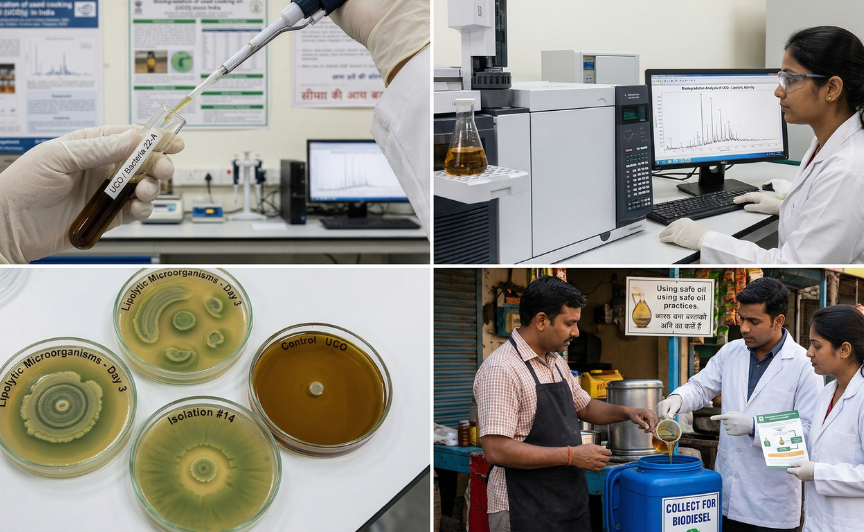
1. Title of the Practice Screening and Detoxification of Toxic Compounds in Used Cooking Oil through Microbial Biodegradation and Awareness Initiative

2. Objectives of the Practice

  • • 2.1 To analyse the quality of repeatedly used cooking oils by detecting harmful compounds such as peroxides, aldehydes, and free fatty acids (FFA).
  • • 2.2 To isolate and identify lipolytic microorganisms capable of degrading toxic components present in used cooking oil (UCO).
  • • 2.3 To create awareness among food vendors and the public about the health hazards of reused cooking oil.
  • • 2.4 To develop a simple domestic testing approach for assessing oil quality.
  • • 2.5 To promote sustainable practices by suggesting conversion of waste oil into biodiesel.

3. Context of the Practice Repeated use of cooking oil is a common practice due to economic constraints, especially in small food establishments. However, reheating oils leads to oxidation, hydrolysis, and polymerisation, producing toxic compounds such as peroxides, aldehydes, and trans fats. These compounds are associated with serious health risks like Cardiovascular diseases, Hypertension, Diabetes, Cancer (colorectal, breast, prostate, etc.). Despite these risks, there is limited awareness and lack of simple testing methods for oil quality at the community level. Hence, this practice addresses both environmental sustainability and public health concerns.

4. The Practice The analytical findings revealed a significant increase in harmful compounds in reused cooking oil, with Sample 7 exhibiting elevated free fatty acid (FFA) levels (0.39%) beyond permissible limits, and Sample 8 showing a high peroxide value (28 mEq/kg). Furthermore, all samples tested positive for aldehydes, confirming the presence of toxic degradation products. Scientifically, the study successfully achieved the isolation of lipolytic microorganisms capable of degrading oil contaminants and demonstrated notable microbial diversity, including both Gram-positive and Gram-negative rods. The awareness initiatives had a meaningful impact, as vendors gained a better understanding of the health risks associated with reused oil and recognized the importance of regular quality monitoring, thereby encouraging a shift toward safer food practices. From a sustainability perspective, the study promoted the conversion of waste cooking oil into biodiesel, contributing to environmental protection and supporting the waste-to-energy concept. Additionally, the project had a strong educational impact by enhancing student learning through hands-on, project-based research and by fostering essential skills in analytical techniques, microbiology, and environmental responsibility.

5. Evidence of Success
5.1 Reused cooking oil samples showed high levels of harmful compounds.
5.2 Sample 7 had elevated free fatty acid (FFA) value (0.39%), exceeding safe limits.
5.3 Sample 8 showed high peroxide value (28 mEq/kg), indicating oxidation.
5.4 All samples tested positive for aldehydes, confirming toxicity.
5.5 Lipolytic microorganisms capable of degrading oil contaminants were successfully isolated.
5.6 Microbial diversity included both Gram-positive and Gram-negative rod-shaped bacteria.
5.7 Awareness programs educated vendors about health risks.
5.8 Promoted safer food handling and usage practices among vendors.
5.9 Encouraged conversion of waste oil into biodiesel.

DEPARTMENT OF MICROBIOLOGY

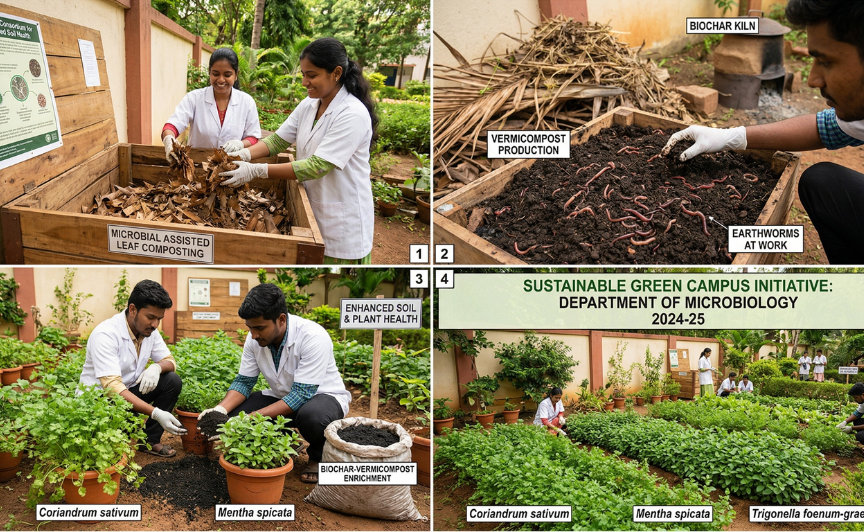
1. Title: Sustainable Green Campus Initiative: Cocos Leaf Composting, Vermicompost Production, and Biochar Microbial Consortium for Enhanced Soil and Plant Health

2. Objective:
  • • 2.1 To promote eco-friendly waste management on campus through systematic composting of fallen Cocos nucifera leaves.
  • • 2.2 To establish a sustainable model of microbial-assisted composting using beneficial microbial consortia.
  • • 2.3 To improve the soil health and biotic fertility of the institution’s garden through vermicompost and biochar–vermicompost application.
  • • 2.4 To support the institution's Environment Cell activity through continuous 3-year organic composting and green-campus maintenance.

3. Context of the Practice The increasing generation of agricultural and garden waste, particularly fallen Cocos nucifera leaves, poses a significant challenge in terms of disposal and environmental sustainability. Conventional practices such as burning or uncontrolled decomposition contribute to environmental pollution and loss of valuable organic resources. At the same time, excessive reliance on chemical fertilizers has led to soil degradation, reduced microbial diversity, and declining soil health. To address these concerns, there is a growing need for eco-friendly, sustainable waste management practices that can convert organic residues into valuable inputs for agriculture.

4. The Practice The practice involved three interconnected components: microbial-assisted leaf composting, vermicompost production, and biochar–vermicompost enrichment and application. Initially, fallen Cocos nucifera leaves were collected and treated with a microbial consortium consisting of Bacillus, Pseudomonas, Streptomyces, Aspergillus, Penicillium, Rhizopus, and Trichoderma species. This resulted in well-decomposed compost within 45 days, which was then transferred to vermicomposting units containing earthworms (Eisenia fetida). Finally, enrichment with biochar improved carbon retention and nutrient-holding capacity. The resulting products were applied to the institution’s garden for growth studies on Coriandrum sativum, Mentha spicata, and Trigonella foenum-graecum, showing significant improvements in plant vigor and soil moisture retention.

5. Evidence of Success
5.1 Significant improvement in soil health and microbial activity.
5.2 Enhanced growth in coriander, mint, and fenugreek trials.
5.3 Reduced dependency on chemical fertilisers over 3 years.
5.4 Visible improvement in campus greenery and garden aesthetics.
5.5 Hands-on skill development for 15 Microbiology students.
5.6 Established a science-driven model for campus ecological practices.

Value-Added Courses and Skill Development

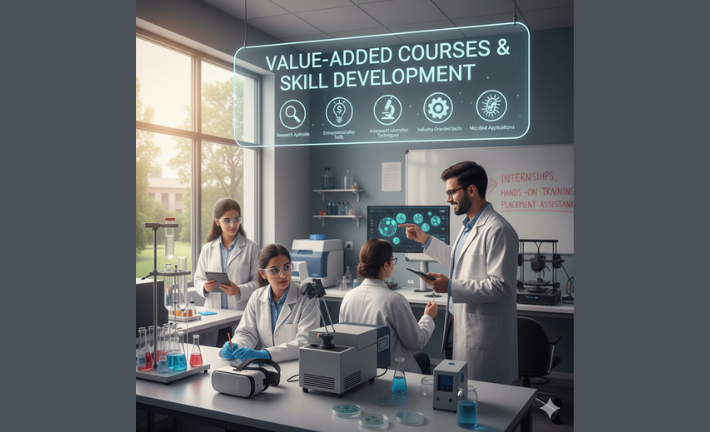
The department offers a range of value-added courses designed to enhance research aptitude and entrepreneurship skills among students. These courses provide additional training beyond the regular curriculum, covering advanced laboratory techniques, industry-oriented skills, and microbial applications. Students also receive support through internships, hands-on training, and placement assistance, preparing them for diverse career opportunities in academia, industry, and start-up ecosystems.
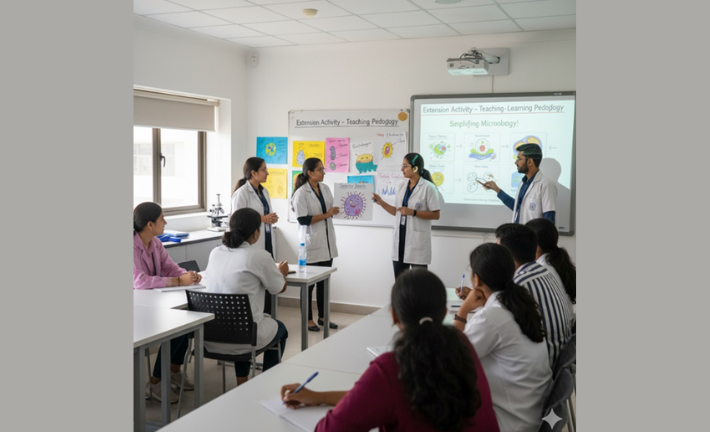

Extension Activity – Teaching–Learning Pedagogy

The extension activity is an innovative teaching–learning approach where postgraduate students take part in teaching school children as part of their curriculum. This activity enhances their communication and presentation skills while enabling them to design creative and student-friendly teaching methods. By simplifying complex microbiology concepts, PG students gain confidence and teaching experience, making the activity mutually enriching for both groups.
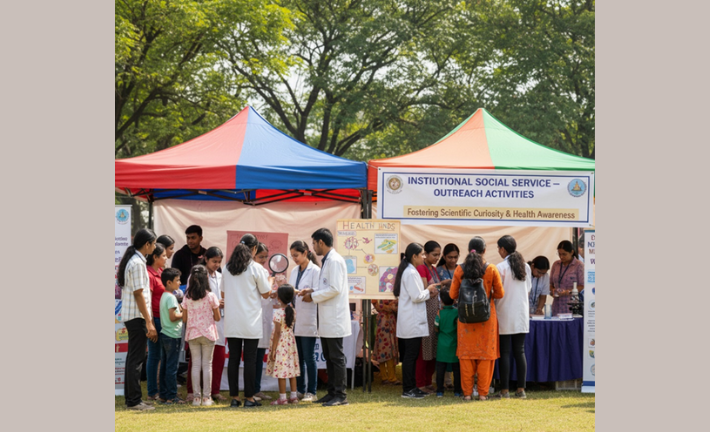

Institutional Social Service – Outreach Activities

As part of the department’s commitment to social responsibility, regular outreach programmes are conducted for the public and school children to create awareness about microbiology and health-related topics. Through interactive demonstrations, exhibitions, and awareness sessions, students communicate scientific concepts in a simple and engaging manner. This initiative strengthens community engagement and fosters scientific curiosity among young learners.
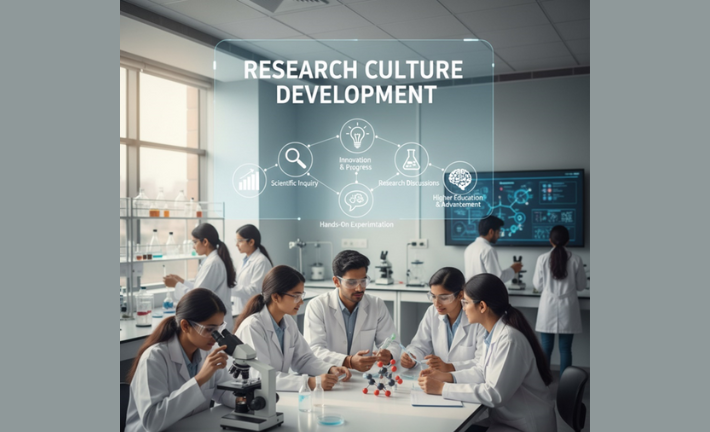

Research Culture Development

The Department of Microbiology actively nurtures a strong research culture among students by providing continuous exposure to scientific inquiry, laboratory-based learning, and mini-projects. Students are encouraged to explore advanced concepts, participate in research discussions, and engage in hands-on experimentation. This initiative motivates them to pursue higher education, develop industry-relevant skills, and contribute meaningfully to scientific advancement and societal well-being.